 Source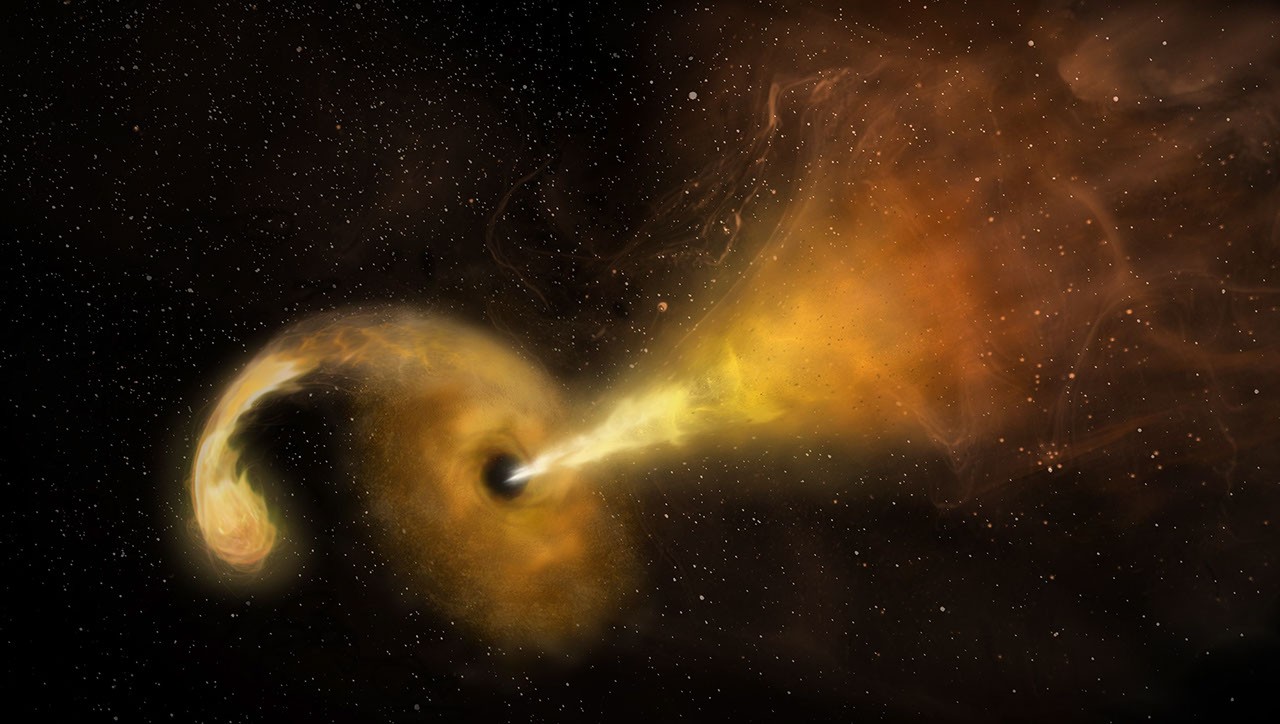
NASA’s Swift Sees ‘Wandering’ Mega Black Hole Shredding Star - NASA Science
NASA's Neil Gehrels Swift Observatory captured a supermassive black hole shredding a star on the outskirts of a distant galaxy. This observation validates a technique for locating wandering supermassive black holes outside galactic cores.
Why it matters
This detection method allows astronomers to find invisible supermassive black holes that are not centered in galaxies. It helps researchers understand how galaxies merge and the movement of these massive objects.
The details
- The event occurred over 30,000 light-years from its host galaxy's center.
- A ZTF AI algorithm first identified the flare in November 2025.
- The black hole weighs approximately one million times the mass of the Sun.
Show entities and relationshipsHide entities and relationships
In this article
Products
Organizations
Countries
Technologies
Key connections
XRT is an instrument on NASA's Swift satellite
Palomar Observatory owns Zwicky Transient Facility
Zwicky Transient Facility operates at Palomar Observatory
UVOT is an instrument on NASA's Swift satellite
Zwicky Transient Facility uses Artificial Intelligence
ZTF survey data is analyzed by an artificial intelligence algorithm to recognize tidal disruption events
Lowell Discovery Telescope is related to Zwicky Transient Facility
Lowell Discovery Telescope conducted follow-up observations of the candidate flare identified by ZTF
Southern Astrophysical Research Telescope is related to Zwicky Transient Facility
Southern Astrophysical Research Telescope conducted follow-up observations of the candidate flare identified by ZTF
Show 12 more connectionsShow fewer connections
Robert Stein works at University of Maryland, College Park
Robert Stein is a research fellow at University of Maryland, College Park
Robert Stein works at NASA's Goddard Space Flight Center
Robert Stein is a research fellow at NASA's Goddard Space Flight Center
Jonathan Carney works at University of North Carolina at Chapel Hill
Jonathan Carney is a doctoral student at University of North Carolina at Chapel Hill
S. Bradley Cenko leads Neil Gehrels Swift Observatory
S. Bradley Cenko is the principal investigator for the Swift mission
S. Bradley Cenko works at NASA's Goddard Space Flight Center
S. Bradley Cenko works at NASA's Goddard Space Flight Center
Palomar Observatory is located in United States
Palomar Observatory is located in Southern California, United States
Southern Astrophysical Research Telescope is located in Chile
SOAR telescope is located in Chile
National Science Foundation funds Vera C. Rubin Observatory
National Science Foundation jointly funds Vera C. Rubin Observatory
National Science Foundation owns Vera C. Rubin Observatory
The Vera C. Rubin Observatory is funded and owned by NSF.
U.S. Department of Energy funds Vera C. Rubin Observatory
The U.S. Department of Energy co-funds the Vera C. Rubin Observatory.
NASA owns Neil Gehrels Swift Observatory
NASA owns and operates the Neil Gehrels Swift Observatory.
Vera C. Rubin Observatory is located in Chile
The Vera C. Rubin Observatory is located in Chile.
Related events
Observation of Wandering Supermassive Black Hole Tidal Disruption Event
Get the weekly recap
The stories like this one, picked and explained — once a week, straight to your inbox.