 Source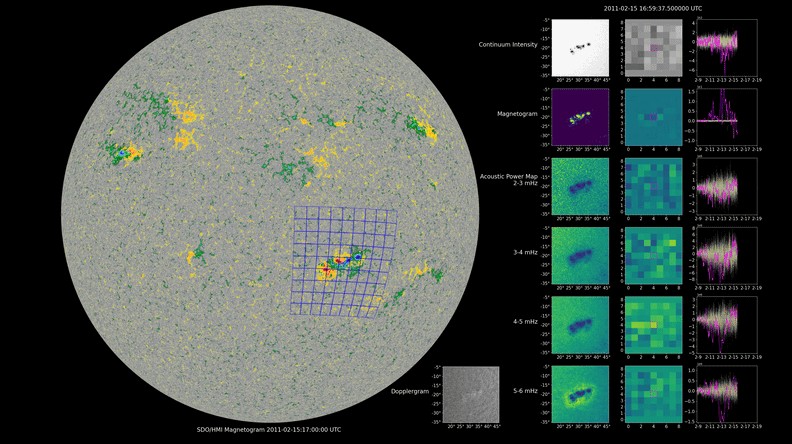
NASA’s COFFIES Uses AI to Predict Storm-Causing Active Regions on Sun
A team with NASA's COFFIES developed a machine-learning model that predicts the emergence of active regions on the Sun up to 12 hours before they appear. The system identifies these regions by analyzing subtle changes in acoustic waves and magnetic fields.
Why it matters
Early prediction of solar storms helps protect satellites, radio communications, and astronauts from high-energy radiation. This capability is particularly important for the safety of crewed missions to the Moon and Mars.
The details
- The model uses a sliding-window transformer architecture to analyze long data sequences.
- Researchers used data from NASA's Solar Dynamics Observatory and Ames supercomputing resources.
- Developing institutions include NJIT, Princeton University, and NASA’s Ames Research Center.
Show entities and relationshipsHide entities and relationships
In this article
Organizations
Topics
Technologies
Countries
Key connections
NASA owns Solar Dynamics Observatory
NASA operates the Solar Dynamics Observatory spacecraft.
COFFIES owns COFFIES AI Model
COFFIES developed the AI model using sliding-window transformer architecture to predict solar active regions.
COFFIES is a NASA DRIVE Science Center established to study solar interior and exterior dynamics.
NASA leads NASA Ames Research Center
NASA Ames Research Center is a major field research center of NASA.
NASA leads Moon to Mars Space Weather Analysis Office
The Moon to Mars Space Weather Analysis Office is an operational monitoring unit within NASA.
NASA leads Space Radiation Analysis Group
The Space Radiation Analysis Group is a specialized operational group within NASA.
Show 17 more connectionsShow fewer connections
NOAA leads Space Weather Prediction Center
The Space Weather Prediction Center is an operational forecasting center of NOAA.
COFFIES is a partner of New Jersey Institute of Technology
NJIT researchers collaborate as co-investigators within the COFFIES Science Center.
COFFIES is a partner of Princeton University
Princeton University researchers collaborate within the COFFIES Science Center.
COFFIES is a partner of NASA Ames Research Center
NASA Ames Research Center researchers collaborate within COFFIES and provide supercomputing resources.
Space Weather Prediction Center is a partner of United States Air Force
NOAA's Space Weather Prediction Center and the United States Air Force monitor solar active regions for operational space weather forecasts.
Community Coordinated Modeling Center is a partner of NASA
The Community Coordinated Modeling Center collaborates with NASA and NOAA on space weather modeling tools.
Alexander Kosovichev works at New Jersey Institute of Technology
Alexander Kosovichev is a researcher and faculty member at NJIT.
Alexander Kosovichev is a member of COFFIES
Alexander Kosovichev is a co-investigator with NASA's COFFIES.
Michelangelo Romano leads Moon to Mars Space Weather Analysis Office
Michelangelo Romano is the deputy director of NASA's Moon to Mars Space Weather Analysis Office.
COFFIES AI Model uses Transformers
The AI model is built using sliding-window transformer architecture.
COFFIES AI Model uses Machine Learning
The COFFIES model employs machine learning to process acoustic and magnetic data.
COFFIES AI Model uses Deep Learning
The model uses deep learning to detect subtle pattern changes on the solar surface.
COFFIES AI Model uses Artificial Intelligence
The model applies artificial intelligence architectures to predict solar active regions.
COFFIES AI Model is related to Space Weather Forecasting
The model advances space weather forecasting capabilities.
COFFIES AI Model is related to Heliophysics
The model applies AI methods to heliophysics and solar interior dynamics.
Solar Dynamics Observatory is related to Space Weather Forecasting
Data from the Solar Dynamics Observatory is used to observe solar activity and train space weather models.
NASA Ames Research Center uses COFFIES AI Model
NASA Ames supercomputing resources were utilized in analyzing data and developing the COFFIES AI model.
Related events
NASA COFFIES Team Develops AI Model to Predict Solar Active Regions Up to 12 Hours in Advance
Get the weekly recap
The stories like this one, picked and explained — once a week, straight to your inbox.